Have you ever wondered why, in the majority of clinical settings, acupuncture needles are retained for roughly 30 minutes? Is this half-hour standard merely a matter of convention, or is there a deeper rationale behind it? The answer is far from arbitrary. It is, in fact, rooted in the precise rhythms of the body's circulation — and, as it turns out, in a body of modern evidence that quietly points in a similar direction.
In clinical acupuncture, treatment does not conclude the moment the needle is inserted. The duration of needle retention is an integral part of the process, as much a part of the "dose" as the choice of points or the depth of insertion. Understanding why the needle stays where it is — and for how long — tells you a great deal about how acupuncture is actually meant to work.
Retention is a clinical variable, not a fixed rule
The length of retention is dictated by the nature of the condition, the waxing and waning of pathogenic and upright Qi, and the rhythmic flow of channel Qi. Put simply: urgent cases demand swift action, whilst chronic conditions require nourishment.
Acute conditions, in which excess pathogens predominate, often call for brief retention — or for rapid insertion and withdrawal altogether. Conversely, chronic conditions characterised by deficiency, or by obstruction due to stasis, typically require a suitably longer retention time to support the Upright, move Qi, and harmonise Ying (nutritive) and Wei (defensive) Qi.
Chinese medicine even has a technique known as "rapid needling" (速刺), where the needle is inserted and withdrawn immediately, without retention at all. This is generally reserved for repletion patterns involving accumulation and stagnation, where a quick manipulation is enough to unblock and vent Qi — treating paediatric food accumulation, for example, or a stye. In acute disorders the pathogen tends to sit relatively superficially, so prolonged retention is unnecessary; something in the region of 15 minutes is often appropriate. For chronic disorders — more often patterns of deficiency or stasis — retention is extended to give Qi time to gather and circulate, with 30 minutes, 60 minutes, or longer being common.
So before we ever arrive at "30 minutes," it is worth saying plainly: retention time is a spectrum, and 30 minutes is simply the point on that spectrum that suits the largest share of everyday cases. The question is why that particular figure recurs — and for that, we turn to the classics.
The classical source: the Fifty Circulations of the Lingshu
Classical texts have discussed the duration of needle retention for two millennia. The most important single passage is the Wushi Ying (Fifty Circulations) chapter of the Lingshu (Spiritual Pivot):
黄帝曰:余愿闻五十营奈何?岐伯答曰:天周二十八宿,宿三十六分;人气行一周,千八分,日行二十八宿。人经脉上下、左右、前后二十八脉,周身十六丈二尺,以应二十八宿。漏水下百刻,以分昼夜。故人一呼脉再动,气行三寸;一吸脉亦再动,气行三寸。呼吸定息,气行六寸。十息,气行六尺,日行二分。二百七十息,气行十六丈二尺,气行交通于中,一周于身,下水二刻,日行二十五分。五百四十息,气行再周于身,下水四刻,日行四十分。二千七百息,气行十周于身,下水二十刻,日行五宿二十分。一万三千五百息,气行五十营于身,水下百刻,日行二十八宿,漏水皆尽,脉终矣。
In translation:
The Yellow Emperor asked: "I wish to hear about the Fifty Circulations; what are they?" Qi Bo replied: "Heaven cycles through the twenty-eight lunar mansions; each mansion has thirty-six divisions. Human Qi completes one circuit in one thousand and eight divisions, and in one day it traverses the twenty-eight lunar mansions. The channel vessels of the human body — above and below, left and right, front and back — number twenty-eight in all. The body measures sixteen zhang and two chi in circumference, corresponding to the twenty-eight lunar mansions. The clepsydra drips one hundred ke to divide day and night. Therefore, with one exhalation the pulse moves twice, and Qi advances three cun; with one inhalation the pulse moves twice, and Qi advances three cun. When breathing is even and settled, Qi advances six cun… In two hundred and seventy breaths, Qi advances sixteen zhang and two chi, making one circuit through the body while the water drops two ke… In thirteen thousand five hundred breaths, Qi makes fifty circulations through the body while the water drops one hundred ke, and in one day it traverses the twenty-eight lunar mansions; the clepsydra is exhausted, and the pulse comes to its end."
The passage is doing something quite elegant: it is measuring the body against the sky, using breath as the clock's second hand.
Decoding the passage: where the half-hour comes from
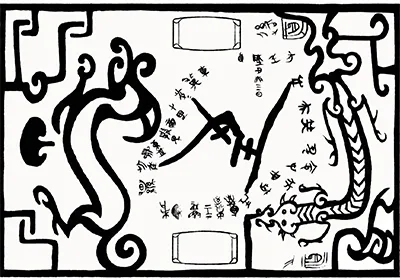
Chinese medicine rests on the unity of Heaven and humanity (天人合一). As the heavens turn, the twenty-eight lunar mansions are observed in sequence; since each mansion is subdivided into thirty-six parts, a full circuit totals 1,008 parts. Over that same circuit, human Qi completes one full revolution — one complete cycle of the waxing and waning of channel Qi across the twelve primary channels, the system later formalised as Ziwu Liuzhu (Midnight–Noon Ebb-Flow).
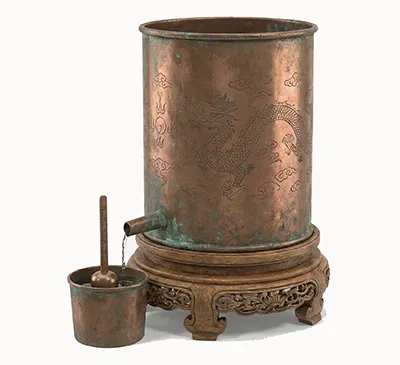
The arithmetic is where it becomes concrete. In antiquity, time was kept with a clepsydra, a water clock. Over one day and night the water drops one hundred ke. Within a 24-hour (1,440-minute) period, then, each ke equals 14.4 minutes — which is why a ke, or "quarter," has long been understood as roughly 15 minutes.
The day is also a single Taiji cycle of Yin–Yang transformation, containing those hundred ke. The text tells us that Qi "makes one circuit through the body while the water drops two ke." Two ke is approximately 28.8 minutes — and over 24 hours, exactly fifty such circuits are completed. You can reach the same figure from the other direction: 1,440 minutes ÷ 50 circulations ≈ 28.8 minutes per circuit.
That single circuit of Ying and Wei Qi — a shade under half an hour — is the theoretical basis for retaining needles for about 30 minutes. The reasoning is that a needling session should span at least one complete circulation of channel Qi, so that the stimulation has time to travel the whole system rather than acting only locally. To reinforce the effect, retention is often extended in multiples of this unit, giving the familiar 60-minute (two circuits) option for stubborn, deep, or deficient patterns.
A second classical clock: the Nan Jing and the rhythm of the breath
The Lingshu is not the only text to run these numbers, and the traditions that favour a shorter retention — 15 to 20 minutes — usually trace back to the Nan Jing (Classic of Difficulties). There, Qi and Blood are said to move six cun with each complete breath, and the total length of the channels and collaterals is given as 1,620 cun. Dividing 1,620 by 6 yields 270 breaths for one complete circuit — the same 270-breath figure that appears in the Lingshu passage above.
The interesting twist is that this makes retention time depend on the patient's own breathing. At a slow, settled 14 breaths per minute, 270 breaths take about 19–20 minutes; at a brisker 18 breaths per minute, only about 15 minutes. This is the classical justification for the 15–20 minute window used in many acute and repletion cases, and it is a neat illustration of a recurring theme in Chinese medicine: the "correct" number is not fixed in the abstract but is calibrated to the person in front of you.
What is actually happening during those thirty minutes
None of this is idle timekeeping. Once a needle is placed and de Qi (得气, the "arrival of Qi") is obtained — that characteristic dull, spreading, heavy or radiating sensation — the retention period is when the treatment does much of its quieter work. Qi is given time to gather at the point, to move along the channel, and to settle into a new equilibrium.
There is a felt, practical dimension to this as well. For most people, the first few minutes after insertion are the most active; then the body downshifts. Breathing slows, muscles release, and many patients drift into the light, restorative state acupuncturists sometimes call an "acu-nap." Ending a session too early can cut this settling short. In this sense the pause is not empty waiting — it is part of the dose.
What modern research suggests
Studies of acupuncture analgesia have repeatedly found that a longer period of stimulation produces a slower onset but a more sustained pain-relieving effect than very brief stimulation. In one experimental study of electroacupuncture duration, 5-minute stimulation gave a quick but short-lived effect, whereas 15- and 30-minute stimulation produced slower-building but longer-lasting analgesia, with the mechanism appearing to shift from a spinal to a more central (supraspinal) one as duration increased. A broader literature review of dry needling and acupuncture for musculoskeletal pain concluded that retention of roughly 15–30 minutes tends to give a stronger and longer-lasting analgesic effect than shorter durations. And a 2025 review of acupuncture for tension-type headache recommended sessions of at least 20 minutes, with 30 minutes preferred for enhanced efficacy.
Different lineages, different clocks
It is easy to assume "30 minutes" is universal, but the major acupuncture traditions calibrate the clock quite differently — and a practice that draws on several of them, as this one does, treats retention as one of the tools of the trade rather than a default.
Japanese Meridian Therapy (Toyohari). This refined tradition works with very shallow, often barely-inserted or contact needling, adjusting Qi through delicate technique and constant pulse feedback rather than through long dwell time. Retention is frequently minimal; the effect is judged moment to moment at the wrist.
Master Tung's acupuncture. Tung's distal points are often combined with dynamic needling (动气针法), in which the patient gently moves the affected area while the needles are in place. Here the "work" of the retention period is active, using movement to lead Qi to the site of the complaint.
Saam (Korean five-element) acupuncture. This system tonifies and disperses through precise four-point combinations chosen by five-phase logic, typically with a moderate retention of around 15–20 minutes, letting the phase relationships do the balancing.
Common questions
Does keeping the needles in longer always work better? No. Beyond the point where Qi has moved and settled, extra time adds little, and for acute or repletion patterns a brief retention — or none at all — is often more appropriate. Longer is not stronger; it is simply suited to different patterns.
Why did my treatment use very few needles, or no retention? Some traditions (Japanese Meridian Therapy in particular) work with minimal, shallow needling and short dwell times by design. Fewer needles is not a lesser treatment; it reflects a different method of adjusting Qi.
Can I move during treatment? Usually you'll be asked to rest still and let the body settle. In certain approaches, such as Master Tung's dynamic needling, gentle movement of the affected area is deliberately encouraged to guide the effect.
Needle retention is not a rigid rule but a dynamic choice, made afresh from pattern differentiation and the rhythmic movement of Qi. Acute repletion conditions favour swift opening and venting, where brief retention is enough. Chronic deficiency or stasis conditions call for tonification and movement, where channel Qi needs more time to circulate, gather and adjust.
When the classical rhythm of the Fifty Circulations is set alongside clinical pattern differentiation — and, quietly, alongside what modern studies of stimulation duration suggest — it becomes clear why the common durations of 15, 30 and 60 minutes are not arbitrary. They are grounded in both empirical experience and coherent reasoning. Ultimately, the art lies in adapting to the individual, the pattern, and the time.
This 24-hour period also represents a Taiji cycle of Yin and Yang transformation. Within this daily Taiji cycle, there are one hundred ke. The passage states that Qi communicates and connects within the centre, making one circuit through the body while the water drops two ke. In other words, every two ke (approximately 28.8 minutes), the Ying and Wei Qi complete one circuit. Over 24 hours, fifty such circuits are completed.
Needle retention is not a rigid rule, but a dynamic choice based on pattern differentiation and rhythmic movement. Acute repletion conditions often emphasise swift opening and venting, where brief retention produces results. Chronic deficiency or stasis conditions place greater emphasis on tonification and movement; here, channel Qi requires more time to circulate, gather, and adjust. When the classical rhythm of the Fifty Circulations is integrated with clinical pattern differentiation, it becomes clear why common durations such as 15, 30, and 60 minutes are not arbitrary, but are grounded in both empirical experience and theoretical reasoning. Ultimately, the key lies in adapting to the individual, the pattern, and the time.