Anxiety, stress & sleep
Acupuncture for anxiety, stress and sleep in Chelsea
For a nervous system that has not switched off in a long time.
Private, one-to-one acupuncture in Chelsea for persistent anxiety, sustained pressure and sleep that no longer restores — offered as complementary care alongside, never instead of, your medical or psychological support.
Who this is for
When "coping" has quietly become the baseline.
Most people who come here are functioning — often at a high level. What has changed is the cost of it.
- Anxiety that has become constant background noise, or a sense of internal pressure that never quite discharges
- A mind that will not switch off, particularly in the evening or at 3am
- Sleep that comes late, breaks in the night, or leaves you unrefreshed however long it lasts
- Stress that has started to show up physically — in digestion, jaw and shoulders, headaches, energy, or how often you get ill
- Feeling simultaneously wired and depleted through a demanding period of work or life
Many people arrive when a pattern has become entrenched, or when they want a non-pharmacological option to sit alongside the care they already have. Care here is individualised and unhurried — the aim is to understand why your system is holding on, not to apply a protocol.
Your care pathway
A clear process, adapted as you go.
- 01 · UnderstandA careful review of your history, current symptoms, sleep pattern, workload and any treatment already in place.
- 02 · SettleIndividualised acupuncture focused on settling the nervous system and restoring the capacity to rest.
- 03 · ConsolidateSessions build on each other; practical guidance on sleep, pacing and recovery is part of the work.
- 04 · ReviewProgress is reviewed at agreed points, and treatment is adjusted, spaced out or paused accordingly.
How it may help
Four things research has looked at.
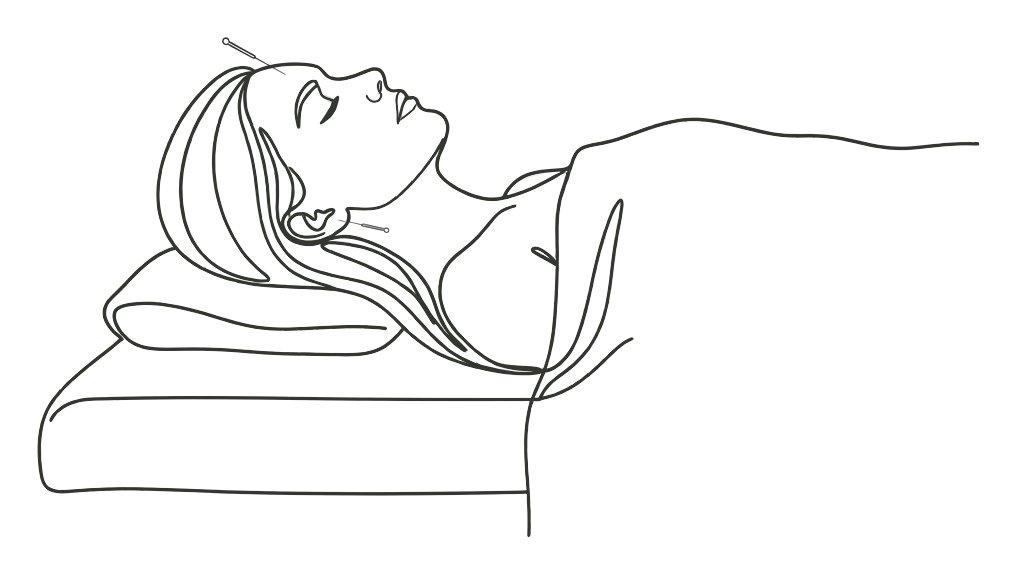
Acupuncture produces measurable effects on the nervous system and the pathways involved in the stress response. What follows is what researchers have examined — offered as context, not as a promise about your outcome.
- A calmer stress responseNeedling activates sensory nerves and prompts the release of the body’s own calming, pain-modulating chemistry — one reason a treatment so often feels like the first genuine pause in a long week. Supports relaxation.
- Autonomic rebalancingAcupuncture is studied for its effect on the balance between the body’s "alert" and "rest" states — the shift many people describe as finally being able to come down from being wired. An active area of research.
- The stress axisResearch examines how acupuncture influences the hypothalamic–pituitary–adrenal (HPA) axis, the feedback loop that governs the body’s hormonal response to sustained pressure. An active area of research.
- Sleep architectureBeyond how rested you feel, studies have measured objective sleep parameters — total sleep time, sleep efficiency and night-time waking — in people with primary insomnia. Measured in sleep studies.
These effects are complementary. They are intended to support regulation and resilience, not to replace psychological therapy or medication where those are indicated. Read more about how acupuncture works.

The treatment itself
Deliberately gentle, because the point is to settle.
For anxiety and sleep, less is usually more. Strong stimulation is rarely what an over-alert nervous system needs.
Phoebus's approach here draws on the Japanese-influenced pulse tradition he trained in over more than five years: read the pulse, place a needle, read the pulse again — letting the body's own response set the dose. In practice this means very fine needles, few of them, and a session that most people describe as the most relaxed hour of their week. Many fall asleep on the couch, which is often the first useful sign. Read about the lineages behind the practice.
Where needles are not the right option — for the genuinely needle-averse, or where sensitivity is high — non-invasive laser acupuncture and very light Japanese-style technique are available instead.
What the research shows
Three bodies of evidence, honestly framed.
Anxiety
Acupuncture for generalised anxiety has been examined in systematic reviews and meta-analyses of randomised controlled trials. A 2021 review in Annals of General Psychiatry pooled twenty trials and reported beneficial effects on anxiety symptoms compared with controls, alongside a favourable safety profile; subsequent reviews have reached broadly similar conclusions while calling for higher-quality trials. The honest summary: encouraging and consistent, not yet definitive.
Stress and the nervous system
Sustained stress involves the hypothalamic–pituitary–adrenal (HPA) axis and the balance of the autonomic nervous system. A 2024 review in the Journal of Integrative Medicine surveys the current understanding of how acupuncture modulates HPA-axis activity — the mechanistic groundwork behind what people report subjectively as feeling less driven.
Sleep
Sleep research is where the picture is most concrete. A 2021 meta-analysis in Sleep Medicine looked specifically at objective measures in primary insomnia — not just how people rated their sleep — and found acupuncture associated with improvements in total sleep time, sleep efficiency and night-time waking. A 2024 review in Sleep Medicine Reviews summarises effectiveness, safety and practical recommendations.
All references are listed at the end of this page.
What to expect
Time to be asked the whole question.
The first appointment is a 90-minute initial consultation and treatment: a detailed review of your history, symptoms, sleep pattern, workload and existing care, followed by treatment in the same visit.
Follow-up sessions are 55 minutes. Everything is private and one-to-one; needles are sterile and single-use. The cumulative effect matters more than any single session, so progress is judged over a series rather than after one visit — and reviewed with you honestly.
Bring a list of any medicines and supplements you take. If you keep sleep data from a watch or ring, it is welcome but not required. View fees & appointment guidance.
In Chelsea
Built for people with demanding weeks.
The clinic is at Roscop Practice, 33B Beauchamp Place, Chelsea SW3 — five minutes from Knightsbridge station, a short walk from South Kensington, and a straightforward journey from Mayfair, Victoria and the City.
Evening appointments on Tuesdays and Fridays until 8pm, plus Saturdays, exist precisely because this is what the working week does to people. Clients come from across SW1, SW3, SW7 and SW10, and often from further afield after work. Clinic details & directions.
Frequently asked questions
Practical answers before you book.
General information, not personal medical advice. Diagnosis and treatment of mental health conditions remain with your GP or specialist.
Is acupuncture suitable if I already take medication for anxiety or sleep?
In most cases, yes. Acupuncture is offered alongside your existing treatment, never as a reason to change or stop it. Please tell your GP or prescribing clinician that you are having acupuncture, and bring a list of your current medicines to the first appointment. Any decision about medication remains with your doctor.
How many sessions will I need?
It varies. Some people notice a shift in sleep or baseline tension within a few sessions; entrenched patterns usually need a more consistent period of treatment. A common starting point is weekly sessions for four to six weeks, with an honest review at the end of it. There is no fixed course and no open-ended programme.
Can acupuncture help with racing thoughts at night?
This is one of the most common reasons people come. Treatment focuses on settling the nervous system and supporting the transition into sleep, alongside practical attention to the habits and pressures keeping the mind switched on.
Is this a replacement for talking therapy?
No. Acupuncture works alongside psychological therapy, not instead of it. Many clients see a therapist and come here for the physical, restorative side of the same problem; the two complement each other well.
Does acupuncture for anxiety hurt?
The needles are extremely fine and, for anxiety and sleep, the technique used here is deliberately gentle — informed by years of training in Japanese-style pulse acupuncture. Most people find the session itself deeply settling, and many fall asleep on the couch. Non-invasive laser acupuncture is available if you are needle-averse.
When is acupuncture not the right choice?
Where there is acute psychiatric risk, thoughts of self-harm, or a need for urgent medical assessment, that care takes priority and comes first. Acupuncture is offered only when it is clinically appropriate, and Phoebus will say so plainly when another route is the right one.
If you are in crisis or struggling to keep yourself safe, please contact your GP, call NHS 111, or call the Samaritans free on 116 123 at any hour. In an emergency, call 999. Acupuncture is not emergency or crisis care.
About the practitioner
Written and reviewed by Phoebus Tian.
Phoebus Ye Tian, BMed, MBAcC — acupuncturist, Chinese medicine practitioner and former clinical lecturer.
Phoebus completed a five-year medical degree at Heilongjiang University of Chinese Medicine, qualified as a licensed doctor of Chinese medicine in China, and worked in a hospital orthopaedics unit before practising in London. He is a member of the British Acupuncture Council (MBAcC), taught at London South Bank University, and authored the "Moxibustion" chapter in Springer's Acupuncture Techniques: A Practical Manual (2024). He was an invited speaker on stress, resilience and practical self-care at the Suicide&Co Self Care Fair in 2025.
References
Selected research, by theme.
Peer-reviewed reviews and meta-analyses on acupuncture for anxiety, stress physiology and sleep, for those who like to read the evidence for themselves.
Anxiety
- Yang XY, et al. (2021). Effectiveness of acupuncture on anxiety disorder: a systematic review and meta-analysis of randomised controlled trials. Annals of General Psychiatry. View
- Li M, et al. (2022). Efficacy of acupuncture for generalized anxiety disorder: a PRISMA-compliant systematic review and meta-analysis. Medicine (Baltimore). View
- Systematic review (2025). Efficacy of acupuncture for generalized anxiety disorder: a systematic review. PMC. View
Stress & the nervous system
- Zhang Y, et al. (2024). Effects of acupuncture on hypothalamic–pituitary–adrenal axis: current status and future perspectives. Journal of Integrative Medicine. View
Sleep
- Zhao FY, et al. (2021). Can acupuncture improve objective sleep indices in patients with primary insomnia? A systematic review and meta-analysis. Sleep Medicine. View
- Zhao FY, et al. (2024). Acupuncture for primary insomnia: effectiveness, safety, mechanisms and recommendations for clinical practice. Sleep Medicine Reviews. View
Begin with one unhurried hour.
Appointments take place privately at Roscop Practice, 33B Beauchamp Place, Chelsea SW3. Evening and Saturday times are available.
Book an appointment