Where TMJ Pain Begins
In London, more and more people are seeking help for TMJ, often noticing it from a minor niggle: a tight jaw upon waking, a sharp click when opening wide to brush teeth, or an ache in the cheeks after eating crusty bread. Sometimes, even the temples begin to throb. You might visit a dentist first, only to be told you’re grinding or clenching under stress. While a bite guard (splint) certainly protects the enamel, that "rock-hard" tension in the masseter muscles remains. Consequently, many are turning to acupuncture to address this muscular strain and referred pain. More often than not, TMJ isn't a case of the joint suddenly breaking; it's the result of clenching your teeth for far too long without realising it.
The real torment lies in how this tension disguises itself as a habit. You might believe you don't clench at all—until someone reminds you to relax, and you notice your upper and lower teeth are constantly touching. Perhaps you only grind during high-stress periods, but your body has already learned to tighten the jaw to gain a sense of control. A dentist’s recommendation for a guard is perfectly logical; it protects the tooth surfaces, reduces wear, and can alter the force of the bite to prevent further joint compression. However, a guard often treats the consequence while the muscular tension continues to run in the background. The masseter muscle becomes like a motor that never switches off—the tighter it gets, the more sensitive it becomes, triggering protective contractions. This leads to restricted opening, chewing fatigue, a squarer jawline, and pain radiating along the temples, the front of the ear, or even the back of the neck. Many assume they need to pop the jaw back or have the bone realigned, when in fact, the priority should be releasing the soft tissue that is constantly firing, allowing the joint the space it needs to glide again.
Grinding and Tension as a Stress Reflex
From a physiological perspective, grinding and clenching aren't just "bad habits"; they are signs that your stress system hasn't shut down for the night. When the sympathetic nervous system is overactive, sleep is shallow, and micro-arousals increase, the orofacial muscles are prone to unconscious contraction. Your daytime emotions and posture further solidify this; for instance, a slumped chest or forward-head posture worsens the coordination between the neck and jaw. To stabilise the airway and head position, the body tends to lock the mandible. The busier you are, the more you clench; the more you clench, the more it hurts—until speaking loudly, yawning, or eating something firm feels like stepping on a landmine. At this stage, simply trying to relax is rarely enough, because while your mind might be trying to let go, the tension is held in neural reflexes and myofascial memory.
The most direct value of acupuncture here is in treating the muscle that has been soldiering on. For many, the first change isn't the immediate disappearance of pain, but a sudden sense of weight in the jaw, as if it is finally willing to drop, and the teeth no longer automatically seek each other out.
How Acupuncture Releases the TMJ
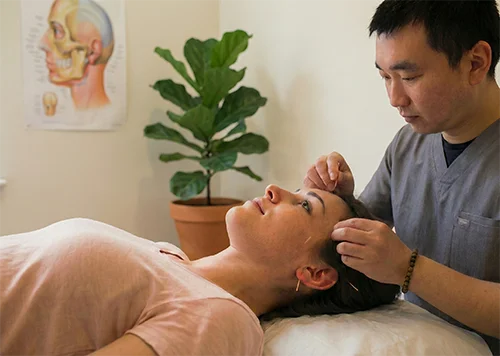
If you think of TMJ pain as a door that’s jammed, a bite guard is like a corner protector for the door, whereas acupuncture is like loosening the rust and knots on the hinges. The masseters, temporalis, and the internal and external pterygoids, muscles at varying depths, work together to control jaw movement. If any layer is hypertonic, it disrupts the gliding rhythm of the articular disc and condyle, leading to clicking, catching, deviation, or pain. Acupuncture uses gentle stimulation to lower this local high tension while influencing pain modulation and muscle tone reflexes. Many feel a dull, heavy sensation spreading from the cheek to the temples or even down to the neck and shoulders; this is a positive sign that the "line of tension" has been located. Crucially, acupuncture often lowers your overall state of alertness. As breathing deepens and the neck and shoulders soften, the jaw finds it much easier to exit combat mode. When the jaw no longer acts as an emotional pressure valve, nocturnal grinding often diminishes, and unconscious clenching during the day, whilst speaking or swallowing, decreases.
People often debate whether to choose a bite guard or acupuncture; in truth, they are often different stages of the same journey. A guard protects the teeth and prevents further joint wear, ideal for those with visible attrition, cracks, or heavy night grinding. Acupuncture targets the cycle of muscular tension and pain, particularly for those whose masseters feel hard to the touch, or who suffer from restricted opening, temporal headaches, and aching in front of the ear. Once the muscles relax, wearing a guard becomes more comfortable and the bite more stable; once mechanical irritation to the teeth and joints is reduced, the muscles no longer feel the need to brace for protection. For many, the turning point is finally moving from constant tooth contact to a natural resting state where the teeth only touch during mastication. It's as if the joint can finally breathe.
TMJ issues rarely happen in isolation; they are tied to how you hold your entire self. The moment you let go of your jaw, you may be surprised to find your chest loosening, your tongue resting properly against the palate, your breathing becoming smoother, and even your stomach feeling less constricted.
Crucially, acupuncture often lowers your overall state of alertness. As breathing deepens and the neck and shoulders soften, the jaw finds it much easier to exit combat mode. This systemic release is backed by recent clinical evidence: a 2024 randomised controlled trial found that acupuncture significantly outperformed sham treatments not only in reducing facial pain and improving jaw opening but also in enhancing sleep quality and emotional function. You’ll find that when the jaw no longer acts as an emotional pressure valve, nocturnal grinding often diminishes, and unconscious clenching during the day, whilst speaking or swallowing, decreases.
The ideal state isn't to clench your teeth again, but for your body to relearn that it doesn't need to clench to maintain stability when you are safe. While acupuncture reduces tension, it also provides the nervous system with a new baseline, showing it that life can be sustained without a tight jaw. Slowly, you regain a more natural jaw position. Your cheeks no longer ache when you speak, you stop worrying about your jaw catching while eating, and you no longer fear the click when you yawn. Once you truly experience a released jaw, you realise that a "stiff upper lip" or a clenched jaw isn't something willpower alone can fix, it’s a result of stress, posture, sleep, and muscle reflexes. Acupuncture’s greatest strength is opening a gap in that muscular defence, allowing the whole system to move towards ease.
Liu, L., Chen, Q., Lyu, T., Zhao, L., Miao, Q., Liu, Y., Nie, L., Fu, F., Li, S., Zeng, C., Zhang, Y., Peng, P., Wang, W., Lin, Y., & Li, B. (2024). Effect of acupuncture for temporomandibular disorders: a randomized clinical trial. QJM : monthly journal of the Association of Physicians, 117(9), 647–656. https://doi.org/10.1093/qjmed/hcae094