Stepping into an acupuncture clinic for the first time, the most common emotion isn’t curiosity—it is nervousness. It is perfectly natural to feel a flutter of nerves before your first session. Your mind has likely already autoplayed the image of needles piercing the skin, perhaps even amplifying the anticipated pain several times over. In reality, the hardest part of acupuncture is rarely the needles themselves, but rather your imagination of the unknown. As long as you know what to expect during the initial consultation, you will find it resembles a profound, quiet conversation with your own nervous system more than a test of endurance.
The initial consultation usually begins with a chat, covering far more ground than you might expect, because people seek acupuncture for much more than just pain. Some attend for fertility support or issues related to infertility, such as menstrual irregularities, ovulation problems, and emotional tension. Others are troubled by digestive complaints, like bloating, acid reflux, and recurring diarrhoea or constipation. There are also those suffering from long-term stress, insomnia, palpitations, and anxiety, with their bodies constantly in a state of high alert. The practitioner will prioritise your primary concern, then delve into how it manifests in your life: when it is most noticeable, how it relates to your diet, sleep, exercise, and work rhythm, and whether there have been any recent stressful events or physical changes. Next come basic observations and checks, such as inspecting your tongue, taking your pulse, assessing abdominal tension, or checking for tenderness and temperature differences in certain areas. Sometimes, they will also observe your posture, breathing, and the way you hold tension in your shoulders, neck, and pelvis. Here, the traditional Chinese medicine methods of inspection, listening, questioning, and palpation serve as a systematic diagnostic framework. The aim is not to attach metaphysical labels to you, but to thread your scattered symptoms into a cohesive line and identify the specific switch that needs adjusting first.
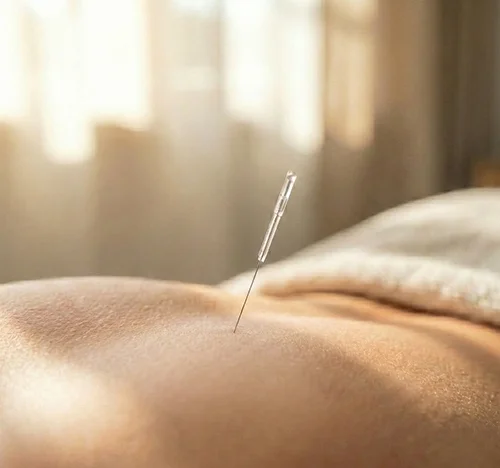
When the treatment properly begins, you will generally lie down, followed by the most critical stage: needle insertion. The sharp pain you imagine rarely occurs; more people describe it as a light mosquito bite, or simply a fleeting pricking sensation that passes instantly. If you subsequently experience aching, distension, numbness, a radiating sensation, warmth, or heaviness, these are often signs of what is known as obtaining qi (De Qi). This can be understood as the reaction of nerves and tissues being awakened, rather than harm being inflicted. Some people feel almost nothing, while others might feel a dull ache spreading along a line; both are within the normal range. More importantly, you can say stop at any time. You can ask for the depth to be adjusted, the point to be changed, or the number of needles to be reduced. Acupuncture is not an endurance competition; the more timely your communication, the more comfortable the experience will be.
The needles are usually retained for about fifteen to thirty minutes. Your task is not to lie there tensed up waiting for it to end, but to give your body a chance to unwind. Many people unconsciously hold their breath the first time, which makes the whole body tighter and actually heightens sensitivity. A very practical tip is to focus your attention on exhaling; as you lengthen your exhalation, your shoulders and jaw will naturally relax, and the needle sensation will feel gentler. Some clinics may add moxibustion, heat therapy, or electro-acupuncture, but these should only be done on the condition that you find them acceptable and the practitioner has explained them clearly. At the end, the practitioner will remove the needles one by one. The speed is fast, and the vast majority of people feel no pain. Occasionally, there may be a slight ache at the needle site or localised redness; this is a normal skin reaction and usually fades very quickly. Many people feel immediately relieved after the first treatment, though some may experience brief fatigue, drowsiness, thirst, or shifts in aching sensations. This resembles the process of the body switching from a state of tension to a repair mode.
The reason acupuncture can feel painless relies not on toughing it out, but on rhythm, technique, and your sense of safety. The clearer you are about the process, and the more you dare to voice your true feelings, the better the experience usually is. It is enough to treat the first session as a trial run—simply to confirm whether you can relax during the treatment, and whether your body shows signs of being lighter, steadier, or sleeping better afterwards. As long as these two answers are positive, your fear of the needles will often have loosened significantly before you even reach your second appointment.