Teeth are a bit like invisible organs in everyday life: when nothing hurts, you barely notice they’re there. But once toothache hits, it can pull you straight out of normal life. You can’t eat properly, you can’t sleep, and even a sip of water can set the nerve off. Talking, chewing, and even brushing your teeth can feel like torture. Many people recognise the pattern: you manage to hold it together during the day, but at night the pain feels sharper, you can’t get comfortable no matter how you lie, and you become irritable and anxious. Toothache might sound like a small issue, but it’s one of the most common problems that can seriously wreck your quality of life.
In Traditional Chinese Medicine (TCM), toothache isn’t seen as simply a bad tooth. It’s linked to how the body’s channels (often translated as meridians) run, how the internal organs function, and whether the overall pattern is more hot or cold, excess or deficiency. TCM describes the Large Intestine channel as reaching the lower teeth, and the Stomach channel as reaching the upper teeth. So, upper-tooth pain is often discussed in relation to the Stomach channel, while lower-tooth pain is more often linked to the Large Intestine channel. If heat builds up in the stomach and bowels — for example from rich or spicy foods, alcohol, late nights, and ongoing fatigue — that internal heat can flare up and travel upwards along these pathways. This is often associated with red, swollen gums, a burning type of pain, bad breath, and thirst with a preference for cold drinks. Another common pattern is wind from an external trigger (roughly like a sudden environmental factor), which can lodge in the channels, transform into heat, and disturb the mouth and teeth. This may come with gum swelling, cheek discomfort, and sometimes pain that is worse on one side.
TCM also places emphasis on the idea that the kidneys govern the bones, and that the teeth are an extension of bone health. In that framework, if kidney yin is insufficient, empty heat (a deficiency-type heat) can rise and contribute to toothache. This kind of pain is often not the classic hot, swollen, angry-looking gum picture. Instead, it can feel more like a dull ache that keeps coming back, gets worse after tiredness or staying up late, and may come with a dry mouth or throat and unsettled sleep. Put simply: an excess heat toothache tends to come on quickly with obvious redness, swelling, and heat; a deficiency heat toothache tends to be recurring, more subtle, and worse when you’re run down. Knowing which direction it leans in can help you choose a more suitable way to ease it.
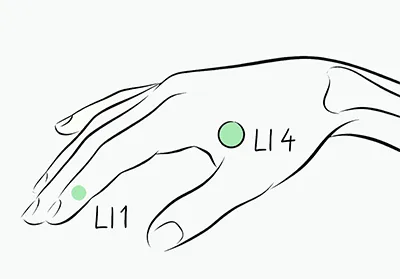
So, when toothache strikes, are there any relatively quick, at-home methods you can try? Below are two commonly used acupoints in TCM: Shangyang (LI1) and Hegu (LI4). They’re often used with the aim of clearing heat, helping the flow along the channels, and easing pain — especially when the gums are noticeably swollen and hot, or when the pain comes on suddenly and you need some short-term relief.
1) Shangyang (LI1)
If your toothache comes with obvious swelling and redness around the lower jaw, clearly swollen and painful gums, or a hot, full feeling in the cheek, TCM would often relate this to Yangming heat — in everyday terms, a heat-type flare-up linked to the stomach and bowels. In this situation, you can try firm acupressure and gentle rubbing on Shangyang (LI1) to help reduce the local swelling and discomfort. Compared with stronger techniques, massage is milder and safer, and it’s easier to do consistently at home.
Shangyang (LI1) is the well point of the Large Intestine channel. In TCM theory, well points are often used to help release built-up heat and unblock the channel. When heat rises along the Yangming pathways, the gums may look red and puffy and feel hot and painful. Applying steady, confident pressure to LI1 — followed by small, controlled rubbing — is used with the idea of helping to drain heat, reduce swelling, and ease pain, particularly where the gums and cheeks feel hot and inflamed.
How to press it more effectively
• Location: on the outer side of the tip of the index finger, right beside the corner of the nail (the side nearer the thumb).
• Use the pad of your opposite thumb to press the point until you feel a clear aching or sore sensation, then add small, gentle circular rubbing.
• Press and rub for 1–2 minutes each time, alternating hands if needed. If the pain is strong, you can repeat several times a day.
• If the gum swelling is pronounced, try a rhythm: press for 10 seconds, relax for 5 seconds, and repeat for 2–3 minutes. This often helps you find and maintain the right deep, sore sensation.
2) Hegu (LI4)
If you’re not sure what type of toothache you have, or the pain is quite sharp and you want a more general-purpose option, Hegu (LI4) is usually the first point people try. In practice, many find that pressing LI4 can take the edge off a range of toothache patterns — upper or lower teeth, one-sided pain, throbbing, or pain that spreads — which is why it’s often described as a go-to point for dental discomfort.
Hegu (LI4) is on the back of the hand, in the web area between the thumb and index finger. To find it:
• Open your thumb and index finger: you’ll see a fleshy peak in the web area — LI4 is in that region.
• With your opposite thumb, trace along the index finger metacarpal (the long bone of the index finger) on the side closer to the thumb. You’ll usually find a spot that feels the most tender or achy — that is typically LI4.
In acupuncture tradition there’s a saying that roughly means for problems of the face and mouth, use Hegu. Its advantages are that it’s easy to locate and often works quickly. When pressed correctly, many people feel the sharpness of toothache reduce, the throbbing settle, and the pain become easier to tolerate — sometimes enough to help you eat or get to sleep.
Key technique (more likely to work)
• Aim your thumb tip slightly towards your chest, and press firmly along the edge of the second metacarpal on the side nearer the thumb, pushing down into the point.
• The goal isn’t a light massage — you want a clear, deep ache, and it may even send a sensation towards the tip of the index finger.
• Keep pressing (or press-and-release) for 3–5 minutes, relax briefly, then repeat 1–3 rounds.
Notes
• For pain relief, the pressure usually needs to be fairly firm, but don’t dig in with your nail or break the skin.
• Keep nails short to avoid scratching.
• If you notice broken skin, bruising, or sharp stabbing pain at the site afterwards, stop and switch to lighter pressure.
Shangyang (LI1) is often used when there’s obvious gum swelling and heat signs, aiming to reduce redness and puffiness. Hegu (LI4) acts more like a general pain switch — for most toothaches, it’s worth trying first.