Lìqiū (立秋) falls on 7 or 8 August. It is the thirteenth of the twenty-four solar terms and the first of the six that make up autumn — and it very often arrives in the middle of a heatwave. That is not a fault in the system. The Chinese calendar marks the turn early, at the point where the days have already been shortening for six weeks and the grain is filling out, rather than waiting for the weather to agree. Anyone who has spent a British August evening sweating in a beer garden and noticed the light going at half past eight has felt roughly what the term is pointing at.
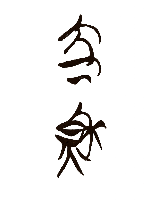
What the name says
Lìqiū opens Mèngqiū (孟秋), early autumn, also called the month of shēn (申). Lì (立) means to establish, to set upright, to put in place. Qiū (秋) means autumn, though early commentators liked to hear jiū (揪) inside it — to gather, to draw in. Both senses sit in the name at once: something starts, and something begins closing.
The Collected Explanations of the Seventy-Two Seasonal Phenomena says as much:
Lìqiū is the seasonal node of the seventh month. Lì means the beginning is established. The energies of the Five Phases pass away and continue one into another at this point. Autumn means gathering in: at this time, things begin to draw together and contract.
The seventh month here is the seventh month of the old lunisolar calendar, not July. The Book of Rites places Lìqiū in early autumn on the same reckoning.
Older writers heard something austere in the season. A passage attributed to Shīzǐ assigns autumn to the west and to solemnity, order and respect. The Sanli Yizong describes it as gathering and shrinking, yin rising out of the earth to check the sprawl of summer. Words like "killing" and "punishment" turn up frequently in this literature, and they read alarmingly in English. Usually they mean frost, harvest, pruning and ordinary decline.
Metal against fire
The Five Phases — Wood, Fire, Earth, Metal, Water — carried the seasons between them: spring Wood, summer Fire, autumn Metal, winter Water. At Lìqiū, Metal takes over from Fire. The trouble is that early autumn is frequently the hottest part of the year, so the handover looks less like a succession than a standoff.
That standoff is how the tradition explains the sānfú (三伏), the three periods of concealed heat, the Chinese dog days. One old calendrical rule counts gēng days after the summer solstice: the third gēng day opens the first fú, the fourth opens the middle one, and the first gēng day after Lìqiū opens the last. The character fú carries the sense of crouching, lying low, keeping out of sight. Autumn's Metal has arrived, but for now it keeps its head down.
Reading the sky
The calendar was anchored in things you could actually look at: the swing of the Northern Dipper's handle, the Sun's position among the lunar lodges, which stars crossed the meridian at dusk and at dawn, and the length of a shadow at noon.
The Huainanzi says that fifteen days after Dàshǔ (Great Heat) the Dipper points to "the axis that turns its back on the sun" — summer's portion is finished, and the cool wind comes. That axis is the south-west. The text names all four diagonals: north-east "rewards virtue", south-west "turns its back on the sun", south-east is Chángyáng, north-west is Títōng. South-west is also kūn (坤) among the Eight Trigrams, which is why later compendia state flatly that kūn governs Lìqiū. In one scheme of waxing and waning, kūn stands at full strength here while the other trigrams sit at various stages of growth, gestation, decline or rest. A reconstruction of the sky in the legendary first year of the Yellow Emperor puts the Dipper's handle towards the south-west at dusk on the day itself.
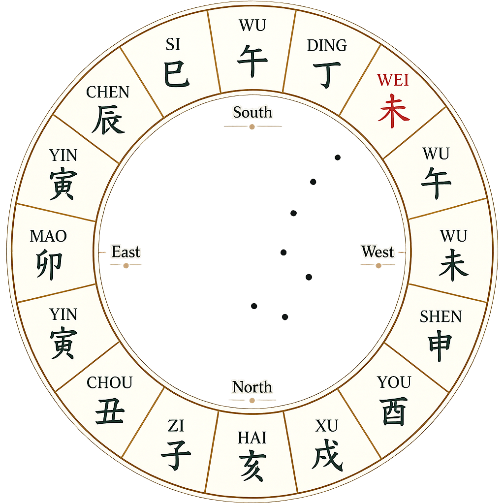
One caution when looking at old Chinese star charts: they show the heavens as seen from below, looking up, so east and west appear on the opposite sides to a modern terrestrial map.
For the Sun, the History of the Han assigns Lìqiū to the eighteenth degree of the division called Chúnwěi, and elsewhere places the Sun in the lodge Yì, the Wings, at the start of autumn. The Book of Rites, the Huainanzi and the Lüshi Chunqiu agree on the wider picture: Sun in Yì, the Dipper or Jiàn on the meridian at dusk, the lodge Bì on the meridian at dawn. These passages come from different centuries and different technical schools, and precession has shifted the background stars since, so they will not stack onto one modern chart. What they show is the method — government, farming and ritual all pegged to something checkable overhead.
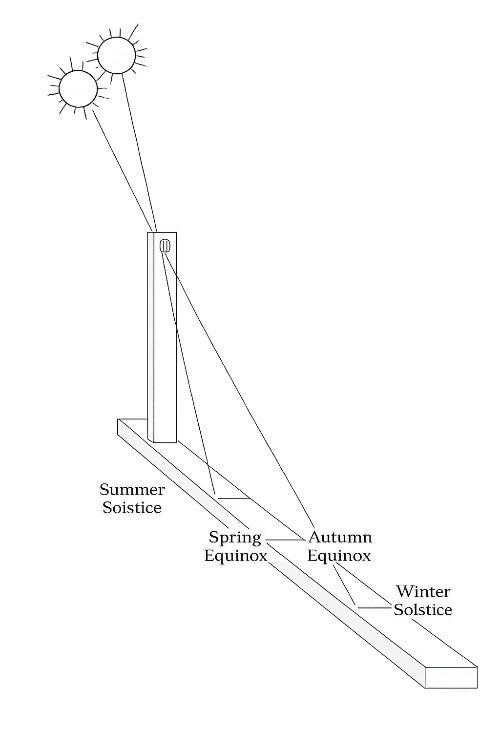
The shadow gave a second check. The Zhoubi Suanjing records the noon gnomon shadow at Lìqiū as four chǐ, five cùn, seven fēn — the modern equivalent depends on which historical units you assume, but it had plainly begun to lengthen again after the solstice. The Former Han Annals reads its rate as an omen: a shadow running ahead of schedule foretells cold, one lagging behind foretells heat, and the irregularity is laid at the ruler's door.
The Moon had nine paths, set out in the History of the Han: two black north of the ecliptic, two red south, two white west, two blue-green east, and a central path through the lodge Fáng. At Lìqiū it takes the white western route, and straying off it meant either drought and wind or cloud and rain — an early attempt at what modern astronomy handles as an inclined, precessing orbit.
Wind, dew, cloud
The cool wind is the first and best-known sign. Forty-five days after the solstice, it dries the millet and grain, repays the earth for its work, and turns the four quarters. On the day of Lìqiū, the cool wind arrives. If the cool wind does not arrive, the state lacks stern government. Wind also had a clinical life. In the Huangdi Neijing, a wind blowing from its proper seasonal direction is full and supports life, while one from the opposite quarter is empty and does harm. At Lìqiū the dangerous wind comes from the north-east, and the text associates it with disorders of the large intestine, the flanks, the armpits and the joints, advising that harmful winds be dodged the way one dodges arrows and stones.
Autumn Chinese medicine
The most quoted passage on the season comes from the Huangdi Neijing:
The three months of autumn are called flourishing and settling. Heaven's influence becomes urgent and the earth's influence becomes clear. Go to bed early and rise early. Keep the mind peaceful, soften the severity of autumn, gather the spirit inward, and do not let the intention scatter outward. Keep the lung influence clear. This is the response to autumn and the way of nourishing gathering. To go against it harms the lungs and may lead to digestive illness in winter.
Go out in the evening and notice how much earlier the light fails than it did in June. Pick some blackberries. Eat the courgettes, beans, tomatoes and early apples while they are good. Mend something, tidy something, put food by — the domestic version of repairing the walls and filling the granaries. And start a notebook of seasonal signs, which only becomes interesting in its second or third year.
The traditional health advice for autumn is all about gathering in: regular hours, a settled mind, care of the lungs, and no reckless spending of energy. Most of it adapts sensibly, provided it isn't asked to do the work of medical care. Use the daylight while it lasts. A walk outdoors most days supports activity, sleep and mood, and the NHS recommends both regular exercise and as much natural light as you can get for people whose mood dips seasonally. Walking, cycling, gardening and some gentle strength work suit the season.
Don't assume the heat has finished. The last fú is a decent reminder that the worst days can come after the calendar has turned. Drink regularly; pale yellow urine is a reasonable everyday sign of adequate hydration.
There is no need for an autumn diet. Eat varied, balanced meals and use what is in season — berries, plums, tomatoes, beans, leafy greens, early apples, with whole grains, protein and unsaturated fats. Soup on a cool evening, salad in a heatwave. Chinese sources link autumn with pungent flavour, which is a symbolic correspondence, not a nutritional requirement, and heavily salted or spicy food doesn't suit everyone.
The lungs get particular attention in the classical texts, and late summer in Britain does bring pollen, mould, air pollution and the start of the respiratory season.
The last piece of gathering in is mental. Finish one or two things rather than starting five more.