The Jin Three-Needle acupuncture was founded by Professor Jin Rui, a renowned acupuncture specialist at Guangzhou University of Chinese Medicine. It has a clearly structured clinical system and a rigorous pattern-differentiation approach, and is widely used in the treatment of common conditions, including nasal disorders. Its core academic thinking stresses regulating the Shen as the guiding principle and point selection as the key. It highlights three-needle point combinations that are concise yet effective, with modifications made according to the presentation. It also values treating the Shen to obtain deqi, applying supplementation or draining based on differentiation, and aiming for a clear needle sensation that reaches the affected area, thereby improving both efficacy and consistency.
Three-Needle protocol for nasal disorders
1. Yingxiang (LI20)
Location: Beside the midpoint of the outer border of the ala nasi, in the nasolabial groove.Indications: nasal obstruction, epistaxis, and deviation of the mouth.Explanation: Ying means to welcome; xiang means fragrance. The point lies beside the nose, where the sense of smell is most responsive, allowing one to detect odours, hence the name. It belongs to the Hand Yangming Large Intestine channel and is a meeting point of the Hand and Foot Yangming. The Hand Yangming vessel runs alongside the nostrils, and the Foot Yangming vessel begins at the nose and connects at this point. As it is located directly at the nose, it is an essential point for treating nasal disorders.
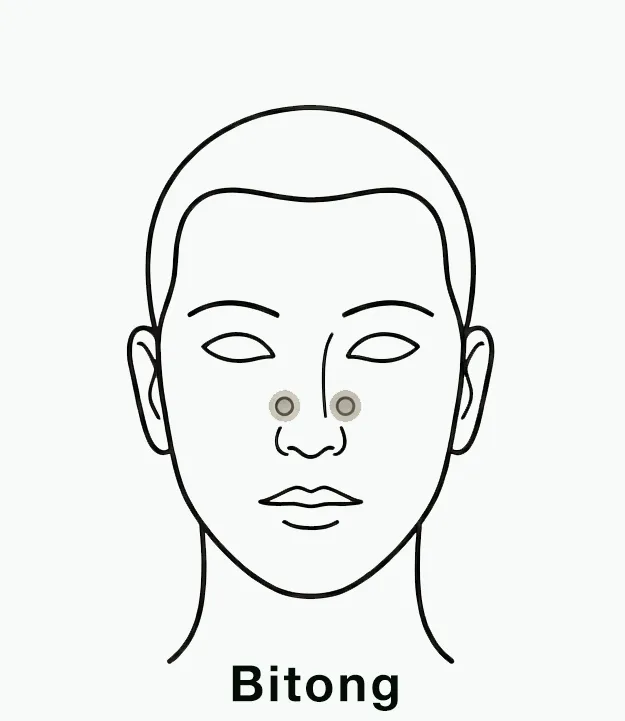
2. Shangyingxiang (Bitong, extra point)
Location: On the face, at the junction between the alar cartilage and the nasal concha, near the upper end of the nasolabial groove.Indications: nasal obstruction, epistaxis, and similar conditions.Explanation: This is an extra point, also known as Bitong. It is located beside the nose and is used to restore nasal patency when blockage is present, hence the name. It is particularly good at opening the nasal orifices and is an important point in clinical treatment of nasal disorders.
3. Yintang (EX-HN3)
Location: On the forehead, midway between the medial ends of the two eyebrows.Indications: headache, dizziness, insomnia, nasal obstruction, acute and chronic rhinitis.Explanation: This is an extra point located on the frontal region. Based on the principle of local therapeutic action of acupoints, it can clear the head and brighten the eyes, and open the nasal orifices, so it is used for head and face conditions and nasal disorders. In addition, it lies along the pathway of the Du channel. As the Du channel ascends to Fengfu and enters the brain, this point can calm the Shen and has a sedative effect, and is commonly used for various forms of dizziness.
Point Combination and Indications
The Nasal Three-Needle consists of Yingxiang (LI20), Shangyingxiang (Bitong), and Yintang (EX-HN3). It was formulated by Professor Jin based on local point selection at the lesion site. The three points are positioned along the upper, middle, and lower margins on both sides of the nasal columella area, which strengthens the local therapeutic effect of the points. Its outcomes are superior to using single points, two-point combinations, or multiple distal points, and it has therefore become one of the more widely used combinations within the Jin Three-Needle system. All three points are key points for nasal disorders. They help to diffuse and regulate Lung Qi and open the nasal orifices, and can be used for chronic rhinitis, allergic rhinitis, and sinusitis, including frontal sinusitis, ethmoid sinusitis, maxillary sinusitis, and sphenoid sinusitis.
One distinctive feature of the Jin Three-Needle system is reflected in the needling technique and needle direction. When using the Nasal Three-Needle to treat rhinitis:
For allergic rhinitis, when needling Yingxiang (LI20), the needle tip should be inserted transversely towards the ala nasi, using a stronger technique with shallow insertion, to the point where tearing occurs. If the patient is asked to take deep breaths at the same time, the effect can be better.
For chronic rhinitis, when needling Yingxiang (LI20), the needle tip should be directed upwards and inserted obliquely along the nasolabial groove. As chronic rhinitis is often related to disorders of the Yangming channel, and Cuanzhu (BL2) is traversed by the Qi of the Yangming and Taiyang channels, Professor Jin considered that Yintang in the Nasal Three-Needle may be replaced with Cuanzhu (BL2).
For frontal distension and pain caused by frontal or ethmoid sinusitis, it is appropriate to combine Yintang (EX-HN3) with Cuanzhu (BL2) to enhance the effect.
Gua Sha Therapy
Gua sha over the distribution area of Tongtian (BL7) on the head, and over facial points such as Yingxiang (LI20), Shangyingxiang (Bitong), Yintang (EX-HN3), and Cuanzhu (BL2).
Gua sha over the distribution areas on the upper back corresponding to Dazhu (BL11), Fengmen (BL12), and Feishu (BL13).
Needling Combined with Moxibustion
Needle Dazhu (BL11), Fengmen (BL12), and Feishu (BL13), and combine with moxibustion.
Overall, the Jin Three-Needle system regulates the Shen to guide treatment as a whole, and uses three-needle combinations to integrate precise local intervention with overall coordination. In treating nasal disorders, the Nasal Three-Needle strengthens local therapeutic action, is paired with standardised needling direction and technique, and can also be combined with external methods such as gua sha and moxibustion to form a more complete, integrated approach. In clinical use, point selection and operational details should be adjusted flexibly according to the nature of the condition, such as allergic patterns, chronic presentations, or different sinusitis types, with the aim of achieving more stable and reproducible outcomes.