Acupuncture to improve the midcheek grooves (Malar Groove) is not just about smoothing the skin; the key lies in rebalancing mid-face support and tissue tension. Midcheek grooves (the oblique grooves of the lower mid-face) commonly appear beneath the malar fat pad apple cheek. With age, they are more readily exaggerated by light and shadow, presenting as an increasingly obvious depression. Using acupuncture as the starting point, this article links the appearance of midcheek grooves to the anchor role of the zygomatic arch ligament, explains why they form, and describes how acupuncture may help by stimulating local circulation, reshaping tissue tension, and promoting repair responses, so the groove appears shallower and facial contours look more three-dimensional.
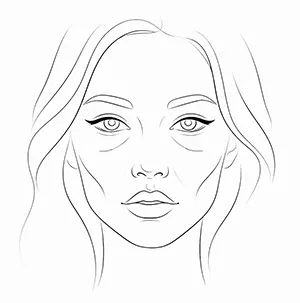
When the support chain begins to fail, grooves emerge quietly. In the three-dimensional architecture of the face, the zygomatic arch ligament acts like a crucial suspension cord”
. It arises from the lateral periosteum of the zygomatic arch and extends down to the subcutaneous fascial layer, serving as a major anchor point of the mid-face. It supports the height of the malar region and stabilises the position of the malar fat pad, helping the mid-face remain full and rounded.
Facial ageing, however, is rarely a uniform collapse. More often, it is a process of differential laxity: areas directly tethered by ligaments may remain relatively stable, while soft tissues that are not directly anchored loosen and descend earlier. Midcheek grooves are precisely the folds and shadows left on the skin surface by this ageing asymmetry, where some structures are pulled, and others are not.
The zygomatic arch ligament: what exactly does it hold in place?
Structural position: The zygomatic arch ligament originates from the lateral periosteum of the zygomatic arch and inserts into the subcutaneous fascial layer. It spans the mid-face and is commonly regarded as an important boundary between the soft tissues of the zygomatic and buccal regions.
Support function: Like a ridge line, it firmly tethers the malar fat pad above to the bony surface, reducing downward migration and maintaining the height of the “apple cheek”.
Anatomical significance: It divides mid-face soft tissue into two relatively distinct zones—a tethered zone and a relatively free-sliding zone. In youth, this partition contributes to natural three-dimensionality and light–shadow modelling; with age, the same partition becomes easier to show through.
Why do the Midcheek Grooves form?
At their core, Midcheek grooves arise from differential laxity. The face does not sag all at once; rather, regions directly pulled by ligaments can remain relatively stable, while tissues without direct anchorage loosen and begin to slide earlier. The zygomatic arch ligament separates the mid-face into a comparatively stable tethered zone and a more mobile free-sliding zone. In younger faces, this structural zoning creates depth and natural highlights and shadows; as ageing progresses, the boundary becomes increasingly apparent.
When the malar fat pad above the ligament remains tethered in a higher position, the soft tissues below or adjacent to it gradually shift downwards under gravity and repeated facial movement. This produces a depression that runs from the inferior border of the zygomatic arch obliquely downwards and inwards. In other words, the groove does not split open suddenly; it develops as a height differential accumulates over time through subtle, repeated tissue displacement. Its direction mirrors the vector of mid-face soft-tissue glide, which is why the line typically takes on that characteristic oblique course.
The reason the groove appears deeper is not solely the indentation itself, but the fact that it lies at the transition between a stable zone and a sliding zone. Unequal tension across this transition sharpens the skin’s light–dark boundary, magnifying shadow and visually deepening the line. As bony support diminishes and the tone of facial expression muscles reduces, the stability of the ligament’s attachment also declines, making the groove more likely to lengthen and to appear as a continuous visual track connecting with the tear trough and nasolabial fold.
Ageing of the zygomatic arch ligament: what happens at the fibre level?
Ageing of the zygomatic arch ligament is first reflected in a weakened “elastic system”. Collagen fibres progressively fatigue, fragment, or become disorganised, and elastic fibres lose recoil. The ligament, once a taut and resilient cord, must both bear the weight of mid-face soft tissue and withstand repetitive traction from facial expression. Once fibre density and recovery capacity fall, it shifts from able to hold to “able to hold, but without enough spring”.
At the same time, the extracellular matrix environment around the ligament changes. With reduced hyaluronic acid and other water-binding components, hydration decreases and the tissue becomes drier, stiffer, and less extensible. A practical consequence follows: when the same traction acts on a drier, stiffer structure, deformation becomes more uneven and local stress concentrates. Over time, certain segments fatigue earlier than others, and it becomes harder to maintain uniform tension.
Repeated gravitational traction and cycles of micro-injury and repair can encourage local fibrotic tendencies and even structural changes such as calcific deposition. Alongside this, low-grade inflammation and oxidative stress reduce fibroblast activity, so repair and renewal cannot keep pace with ongoing wear. The tension network therefore, becomes uneven—some areas remain relatively tight, while others loosen and collapse first. Once this imbalance reaches the surface, it is amplified by light and shadow, ultimately producing a more pronounced “groove differential”.
How can needling target the zygomatic arch ligament and mid-face tension?
Precise needle placement: locking onto the ligament anchor
Needling around the ligament’s attachment area aims to promote local circulation and tissue-repair signalling through mechanical stimulation and a controlled micro-injury response.
Reducing the tension gradient: making load-sharing more even
Needling may activate fibroblast-related responses and collagen remodelling, helping the ligament and surrounding soft tissues converge towards a more consistent tension profile and reducing the disparity between tethered and collapsed areas.
Supporting new collagen formation: repairing fatigued segments.
Through a micro-stress repair response, related growth factors and repair pathways may be upregulated, improving ligament elasticity and the stability of its attachment.
Overall lift: restoring mid-face three-dimensionality
As ligament tension improves, tissues above are more likely to return towards a higher position, while traction and shadow over the lower depression may lessen:
• On the surface: the depression appears shallower, and shadows lighten;
• In three dimensions, the apple cheek looks higher, and the visual linkage between the tear trough and the nasolabial fold is interrupted.
• In motion: expressions look softer, and the skin’s rebound feels better.
The zygomatic arch ligament is a key watershed for a youthful mid-face. Areas it tethers are more stable; areas lacking its direct support descend more readily. Malar Grooves are the trace left when this tension gradient is magnified by light and shadow. When needling takes the ligament as its target, activating the anchor, reshaping tension, and enhancing attachment stability, it is akin to installing a renewed suspension system for the mid-face, lifting descended tissue, softening grooves, and restoring three-dimensional contour.
Risks of cosmetic acupuncture
Adverse effects of cosmetic acupuncture are very rare. Reactions that usually resolve on their own include soreness, tightness, or brief sharp sensation at the needle site; local redness or warmth; mild swelling; bruising/ecchymosis (typically improving over several days); a small amount of bleeding; transient dizziness, sweating, or fatigue (often related to anxiety, an empty stomach, or low blood sugar); and mild tiredness or increased sleepiness on the day of treatment or the following day.